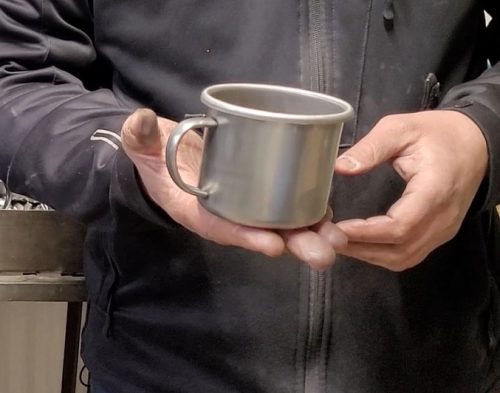
How Are Enamel Mugs Made?
From a sheet of steel to a finished product – inside the Olkuskie Wyroby Emaliowane workshop.
At first glance, an enamel mug looks wonderfully simple. A metal body. A handle. A distinctive rim. A smooth, colourful surface. But behind that simplicity lies something surprisingly complex.
Before a finished enamel mug reaches your desk, kitchen, camper van or backpack, it can pass through the hands of up to 20 people. And every stage matters.
Enamel is beautiful, durable and remarkably resistant, but it is also unforgiving. A small mistake during preparation, coating or firing may only become visible after the mug leaves the furnace.
That is why genuine enamelware still relies so heavily on human experience, precision and craftsmanship. So how does a simple sheet of steel become a mug made to last?
Let’s follow its journey.
01
It all starts with the right steel
Not every type of steel can become an enamel mug.
During firing, enamel must permanently bond with its metal base. That’s why we use enamelling-grade steel with carefully selected chemical and surface properties.
The wrong base material can lead to cracking, poor adhesion or enamel separating from the steel — sometimes during manufacturing and sometimes much later, while the product is being used.
You may never see the steel underneath your finished mug. But without the right steel, even the finest enamel cannot do its job.
02
From a flat sheet to a three-dimensional mug
This is where the transformation really begins.
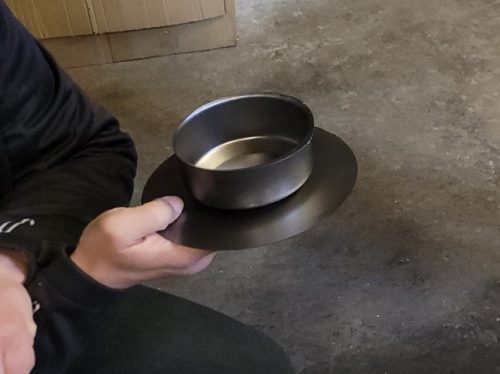
Steel sheets are cut and shaped using industrial presses until the familiar body of a mug begins to emerge.
Depending on the model, the manufacturing process includes several precise operations:
- shaping the body and rim
- attaching the handle
- finishing the edges
- checking dimensions and proportions
At this point, the mug looks nothing like the colourful object you might eventually hold in your hands. It is raw. Metallic. Industrial. And rather beautiful in its own way.